
How to Check Criminal History in Sparta
Start at the point where the Sparta record was made. Sparta Police reports remain with the municipal custodian unless another agency handled the event. Booking and present-custody questions go to the sheriff-run jail. Sparta charges, hearings, and outcomes belong to the clerk and the statewide eCourts Portal. For a person's own fingerprint-supported North Carolina history, the official route is SBI Right to Review rather than a Sparta name search.
- Call Sparta Police at 336-372-4252 for a Sparta incident or arrest report and identify the event as closely as possible.
- Ask for the public portion of the specific report, giving the date, time, place, report number, and involved name when known.
- For charges and outcomes, search eCourts Portal with Alleghany selected and confirm the result with the Clerk at 336-372-3900.
- For very recent custody, call the Alleghany County jail at 336-372-4455 because Sparta has no public local roster.
- For one's own statewide repository file, follow the fingerprint-based SBI Right to Review process.
These channels are complementary. A police report may describe an allegation that never becomes a court charge. The court record may show a later dismissal or amended charge. A jail call answers a present-custody question but cannot certify a full Sparta criminal record.
Sparta Police Records by Numbers
Sparta's proposed fiscal 2025-26 budget gives a useful, carefully limited view of police work during 2024. Sparta officers handled 4,538 service calls, filed or investigated 699 incident reports, made 7,389 business checks, and investigated 86 crashes. These Sparta workload counts are not a tally of crimes, arrests, or convictions. Business checks are preventive patrol work. A service call can end without a written incident report, and an incident report can document conduct that produces no charge.
The 699 incident reports are the closest published measure of records likely held by Sparta Police, but even that count covers many outcomes. Crash reports also follow a different access path unless a citation or charge enters court. Readers should not add the figures together or label the sum a crime count.
The official Census profile for Sparta supplies the population context for Sparta's records workload.
That source places the police workload in Sparta's small-town setting without turning calls, checks, and reports into unsupported crime rates.
The Sparta Police Department
Sparta Police is the custodian to contact for records created by its officers. The Sparta department publishes a telephone number, fax line, and mailing address, but no public records email, counter hours, request form, online report portal, blotter, app, or fee schedule. Call 336-372-4252 before sending a request. The fax is 336-372-2624, and mail goes to P.O. Box 1018, Sparta, NC 28675.
The official Sparta Police page shows the direct police contact and Sparta's town identity.
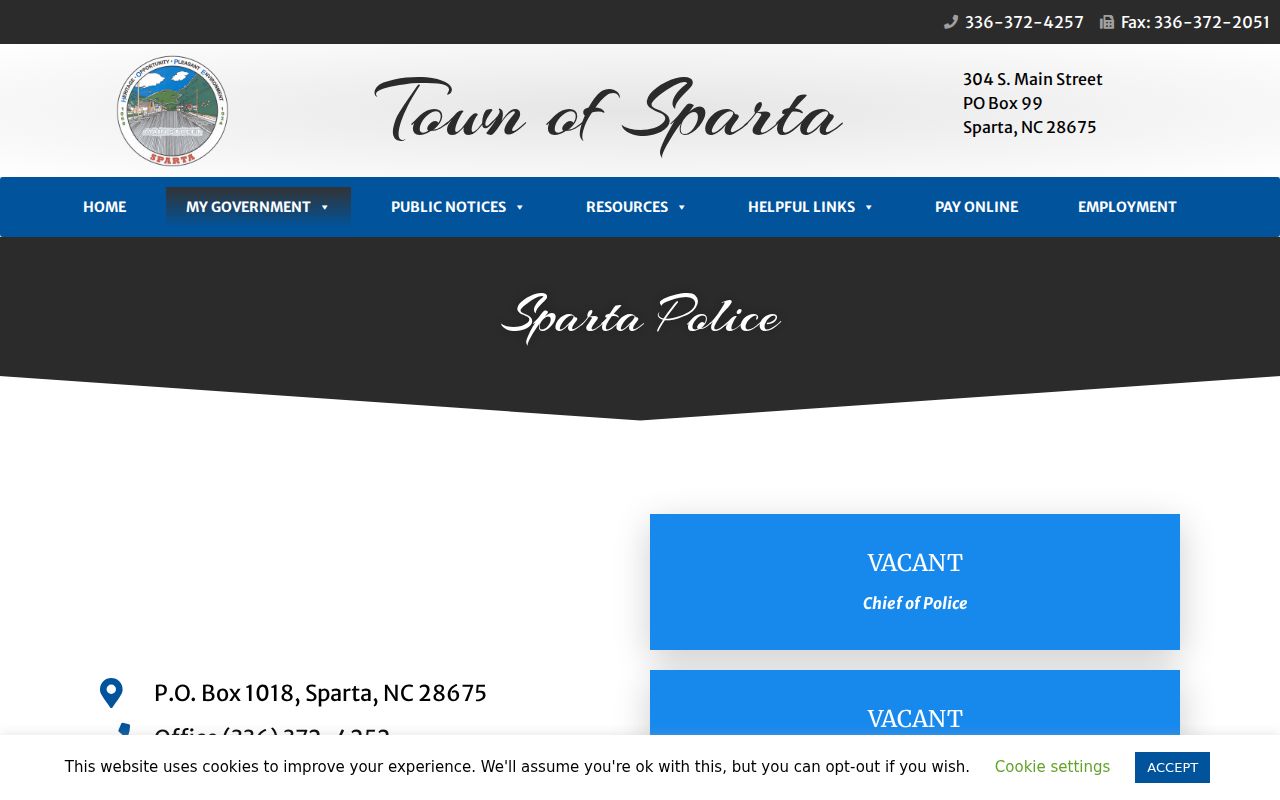
Because the page omits a dedicated records process, the practical route is to call, name the exact record, and confirm cost, identification needs, delivery method, and pickup details.
Ask for an existing product rather than “everything.” A clear request might identify a public incident-information sheet by date, location, event number, and involved name. If the request concerns recordings, ask which law applies. Body-worn camera material has a special process under §132-1.4A and should not be treated like an ordinary paper incident sheet.
Sparta CAD and Crash Records
Sparta's recent in-car CAD and TraCS work helps explain why local records may sit in different systems. CAD holds dispatch and unit activity. A dispatch entry does not by itself show that a crime, arrest, or formal report followed. TraCS supports traffic and crash documentation. A crash record normally follows the investigating-agency or North Carolina DMV route unless an officer also issued a citation or filed a criminal charge.
Sparta also renovated its evidence storage. Evidence custody is not the same thing as public access to evidence. A Sparta request for a report, a dispatch entry, crash material, or evidence-related record should name that product. If an investigation remains active, Sparta Police may withhold protected investigative details while still releasing the specific public facts listed in §132-1.4(c).
Note: Ask Sparta Police which system holds the item before assuming one report number retrieves dispatch, crash, evidence, and court records.
Arrests and Bookings in Sparta
A Sparta officer creates the Sparta incident or arrest record. When detention is required, the record trail moves to the Alleghany County Detention Center, which the sheriff operates. That booking arrangement is a supported operational inference from Sparta and county duties; no separate public agreement was located. The county does not publish a jail roster or booking blotter, and Sparta has no city holding roster.
For a very recent custody question, call the jail at 336-372-4455. For the circumstances of the event, call Sparta Police. After charging papers reach court, use the Clerk or Portal. Those three contacts may describe different stages of the same episode. The initial arrest charge can be amended, dismissed, or replaced, so the court disposition is needed before drawing a conclusion about the result.
For a fuller county-wide explanation, use the Alleghany County arrest history resource. Sparta-specific report questions still belong with the Sparta Police custodian.
Four Sparta Criminal Record Systems
One Sparta event can create four distinct records. The police report describes the call, incident, and initial enforcement action. A sheriff booking record establishes intake and custody. The clerk case records filed charges, hearings, and disposition. Fingerprints and later disposition reports can update the North Carolina State Bureau of Investigation repository cycle.
- Incident record
- The Sparta Police account and public incident facts tied to the event.
- Booking record
- The sheriff-run jail intake, custody, bond, hold, and release information where maintained and public.
- Court case
- The Alleghany clerk's docket of filed charges, hearings, court events, outcome, and judgment.
- SBI cycle
- The fingerprint-supported state identity-history event and reported disposition.
No one layer safely substitutes for the others. A missing Portal result may reflect filing lag, spelling, an older paper record, or a restricted matter. An NCDAC offender search concerns state prison or supervision and is not a Sparta jail list.
Sparta Municipal Court Records
Sparta has no municipal court. Town misdemeanors, infractions, traffic matters that enter the criminal system, and failures to appear route into North Carolina's unified General Court of Justice. Alleghany District Court handles misdemeanors, infractions, and early felony matters. A felony that is transferred or indicted proceeds in Superior Court. Both divisions use the Clerk of Superior Court at the county courthouse.
The official Alleghany County court page is Sparta's local judicial route for calendars, forms, and services.
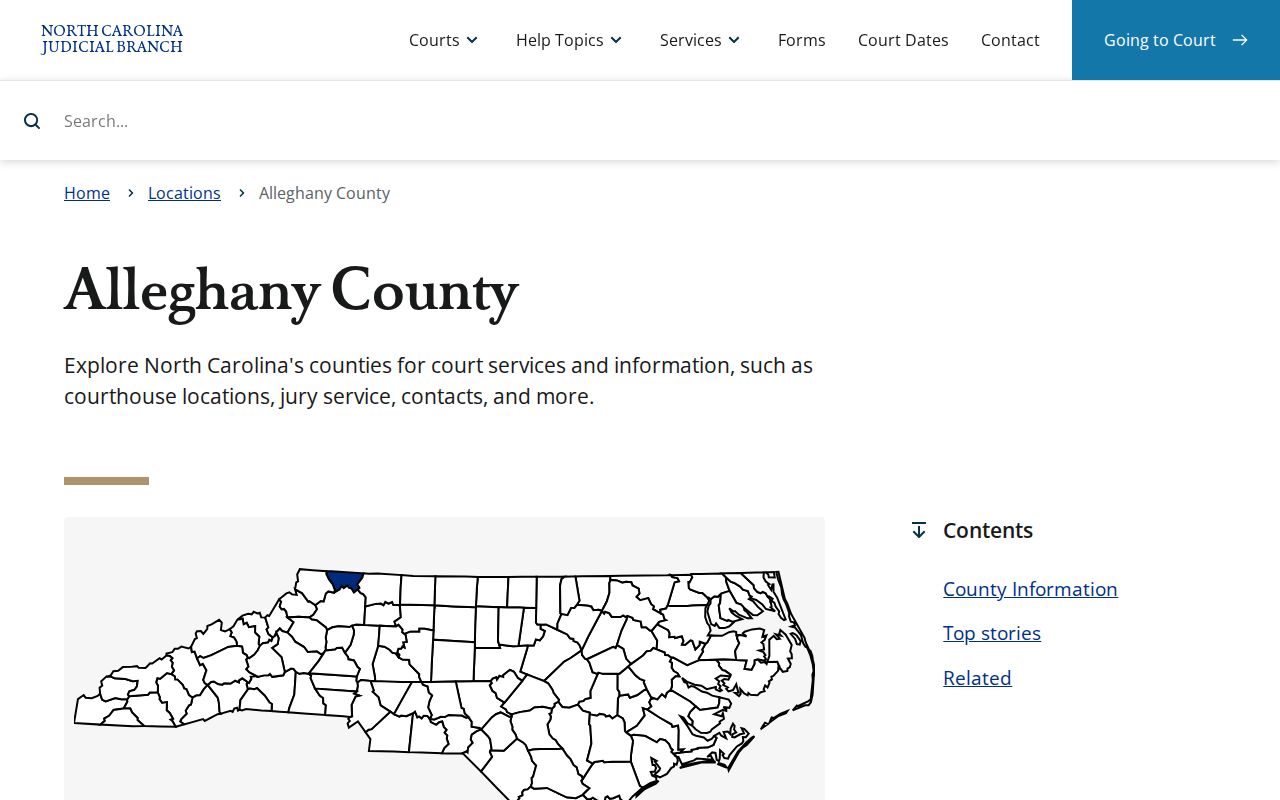
The image reflects the key local distinction: Sparta cases use the county court system rather than a Sparta-run municipal docket.
| Court Name | Alleghany County District or Superior Court in the North Carolina General Court of Justice. |
|---|---|
| Case Types Heard | District Court handles misdemeanors, infractions, and preliminary felony matters; Superior Court hears felonies. |
| Case Lookup Channel | eCourts Portal, the public clerk terminal, or the Clerk at 336-372-3900. |
| What the Docket Shows | Case number, parties, charges, events, hearings, disposition, judgment, and public financial entries when applicable. |
| Copies and Search Fee | Ask the clerk about copy fees; the official certified single-county search uses AOC-CR-314 and costs $25. |
No Sparta Records Portal
The absence of a Sparta police portal changes the order of work. Begin by telephone, learn who serves as custodian, and request a narrowly described existing Sparta record. Confirm any fee, identification rule, delivery choice, and expected response before relying on assumptions. Sparta publishes no firm price, turnaround promise, 911-audio retention period, or certified-report procedure.
Do not send a Sparta-held police request automatically to county administration. The county Chapter 132 form is useful for county records, but each agency controls its own files. A sheriff response belongs with the county custodian. A Sparta officer's record belongs with Sparta Police. A Highway Patrol crash may follow another state channel. When the agency is unclear, give both offices the time, place, and event number and ask which one made the primary report.
Where Sparta Records End Up
Sparta Police records stay with the Sparta municipal custodian at the incident stage. A custody event creates a separate sheriff jail record. Once a citation, summons, warrant return, or criminal charge is filed, the judicial copy belongs to the Alleghany Clerk. Fingerprints and later court dispositions can then update the state repository maintained by SBI's Criminal Information and Identification Section.
Record flow: Sparta Police › Alleghany County Courts › North Carolina State Bureau of Investigation
Timing explains many mismatches. A fresh police report may exist before Portal has a case. The filed charge can differ from the officer's first label. SBI data may wait for fingerprint or disposition reporting. Searchers should match each question to its record: police for the event, sheriff for custody, clerk for the case, and SBI for one's own statewide fingerprint history.
Sparta Records at Town Scale
Sparta is Alleghany County's only incorporated municipality and its county seat. The official 2024 estimate listed 1,929 residents, while the 2020 Census counted 1,834. Sparta sits at about 2,927 feet and spans roughly 2.37 square miles. The Census Alleghany County QuickFacts provides the wider county setting. Sparta police, court, sheriff, and municipal counters are close in geographic terms, yet their records remain legally and operationally distinct.
The official Town of Sparta source shows the municipal setting centered on Town Hall.
Town Hall at 304 South Main Street anchors municipal government, while police mail goes to a separate post-office box and court files remain with the county clerk.
That compact layout can make a broad “Sparta record” request sound simple when it is not. Name the office and record type. Historic material also requires care: Alleghany County was formed from Ashe County in 1858-59, so much older regional records may predate the current local system.
Sparta Calls Are Not Convictions
Police workload measures must be read by the act they count. A business check is patrol. A call is a request or dispatch event. An incident report documents an allegation or response. An arrest records custody. A filed charge begins a court matter. A conviction is a judgment after a plea or verdict. The county-wide 2025 Alleghany Violence Profile also uses its own scope and year. Moving from one label to the next without checking the record can turn a sound public fact into a false claim.
| Sparta Record | What It Establishes | What It Does Not Establish |
|---|---|---|
| CAD or service call | Dispatch or unit activity | That a crime or arrest occurred |
| Incident report | An event was documented | That the allegation led to a charge |
| Booking | Jail intake and custody | That the person was convicted |
| Court judgment | The filed charge's legal outcome | Every fact in the police investigation |
Note: Use the final court disposition when the question is how a Sparta charge ended, and never treat an arrest as proof of guilt.
Sparta Police Programs and Records
The proposed Sparta budget documents several active police projects: in-car CAD, TraCS, evidence-room work, Coffee-with-a-Cop, Teen Court, a $30,000 Governor's Crime Commission radio grant, and continued support from a federal COPS grant. These programs reveal how varied Sparta Police records can be. A community event, juvenile diversion activity, radio grant file, crash entry, and criminal incident do not follow one public-access path.
Teen Court and related youth work also require restraint. Juvenile law-enforcement and court material is generally confidential, even when a public budget identifies the program. A program's name and public funding do not make participant files public. Ask Sparta Police or the proper program custodian for releasable administrative records without seeking protected youth case details.
Public Access Rules
North Carolina law starts with public access but preserves specific limits. A Sparta custodian generally permits inspection or copies of public records at reasonable times and may redact protected details. The law does not require Sparta to create a new report or custom compilation. Active investigative intelligence, confidential source material, protected personal data, juvenile records, sealed matters, and some recordings may be withheld or handled under a special process.
If a broad request is denied, ask for the legal basis and narrow it. For an active police matter, ask whether Sparta can release the enumerated public facts, such as the time, date, place, nature of the reported violation, apparent offense, arrest details, and description of seized items. A Sparta court pleading or judgment should go to the clerk instead.
Key Statutes:
North Carolina Public Records Law, Chapter 132 defines public records and supports inspection and copying subject to stated exceptions.
N.C.G.S. §132-1.4 separates public incident and arrest facts from protected criminal-investigation or intelligence material.
N.C.G.S. §7A-109 makes court records generally open under clerk supervision and permits defined forms of remote access.