
Criminal Cases in the Alleghany County Courts
North Carolina uses one General Court of Justice, so Alleghany County does not have separate elected clerks for felony and misdemeanor files. The Superior Court Division hears felony trials. The District Court Division handles misdemeanors, infractions, juvenile matters, and the early steps in felony cases. Both divisions work from the courthouse in Sparta, and the Clerk of Superior Court keeps each public case file. A felony can begin with a District Court appearance and later move to Superior Court after indictment or transfer.
The case file is the right source for charges as filed, pleas, motions, hearings, judgments, and sentences. It differs from a deputy's arrest report or the jail's booking entry. Alleghany County is part of court District 34 with Ashe, Wilkes, and Yadkin counties, but a local filing remains with the Alleghany clerk. The official Alleghany County court directory identifies the clerk, judges, prosecutor, and magistrate contacts.
Alleghany Court Divisions Compared
Knowing the division prevents a search from stopping too soon. District Court is the starting point for local misdemeanors and most preliminary felony work. Superior Court is the felony trial court. The magistrate handles initial process and release decisions, while the District Attorney prosecutes for the state. None of those offices replaces the clerk as the custodian of filed case records.
| Alleghany County office | Main case role | Contact |
|---|---|---|
| Superior Court | Felony trial, judgment, and qualifying expunction matters | 336-651-4416 |
| District Court | Misdemeanors, infractions, and early felony proceedings | 336-651-4412 |
| Clerk of Superior Court | Both divisions' files, public terminal, copies, and certifications | 336-372-3900 |
| Magistrate | Initial process and release conditions | 336-372-4911 |
| District Attorney | State prosecution, not clerk copies | 336-372-3910 |
For an upcoming appearance, use Search Hearings or the CourtDelta link on the official Alleghany County courthouse page. CourtDelta asks for contact details and a case or citation number, but it finds dates rather than a complete criminal case history.
The Judicial Branch directory shown here is the source for these court contacts.
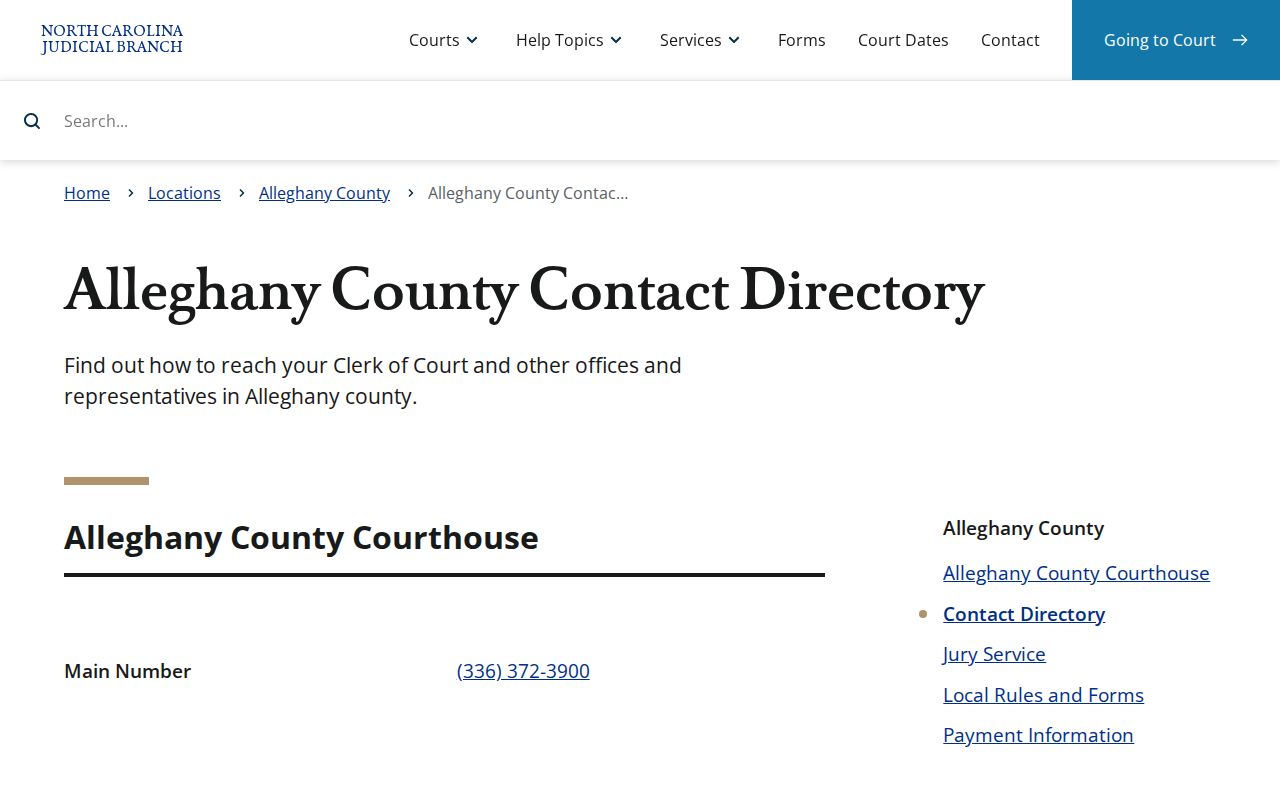
The directory helps a caller reach the office tied to a docket question instead of sending a records request to the wrong custodian.
How to Search Case Records
The free North Carolina eCourts Portal is the first remote channel for a known Alleghany County criminal case. Portal is an index and public case summary, not a certified background check. Use the exact case number when possible. For a name search, match the filing county, charge, filing date, and disposition before concluding that a result belongs to the person sought.
- Open Smart Search and choose Alleghany County in the location filter.
- Enter the full case number, or search the party name with the official wildcard format.
- Narrow results by criminal case type, status, filing dates, or available birth information.
- Open the Case Summary and read events, hearings, charges, and each disposition.
- Use the clerk terminal or ask the clerk for the filed document, copy, or certified search when the index is not enough.
The controls documented in the official Portal training resources support both broad and exact searches.
| Field or control | Type | Required | Format or use |
|---|---|---|---|
| Search | Text | Yes | Case number or party name |
| Location | Multiselect | No | Choose Alleghany County |
| Party criteria | Advanced fields | No | Name and birth date where available |
| Case category and status | Filters | No | Criminal Actions and open or disposed status |
| Filing date range | Date range | No | From and to dates |
| Hearing keys | Text and selectors | No | Case, party, attorney, judge, or courtroom |
Alleghany eCourts Changed Case Access
Alleghany County joined the statewide eCourts system on July 21, 2025 as part of Track 9. The change added Enterprise Justice, Portal, and electronic filing tools described in the Judicial Branch's digital-courts overview to a courthouse that still supports counter and paper-file access. The online layer is useful for recent public entries, but it did not turn every old document or restricted file into a web record. Searchers should treat the launch date as context when a case is older or a document is missing from the public view.
The Judicial Branch's official Alleghany eCourts launch notice documents when the new court system went live.
The dated notice explains why current Alleghany County case work spans a digital index, clerk terminals, and records that still require staff help.
What the Case File Shows
An Alleghany County criminal case file records what happened after process reached court. The most useful items are the charging document, event list, orders, disposition, and judgment. A calendar can show where and when a hearing is set, but it cannot supply the full procedural history. Financial entries may include costs, fines, restitution, appointed-counsel fees, or probation fees when they apply.
| Case Number & Court | Filing year, case type, sequence, county identifier, division, and status. |
|---|---|
| Charging Document | The filed accusation, offense description, statute, class, and charge sequence. |
| Docket Entries | Register of Actions dates for filings, motions, orders, and other events. |
| Hearing Dates | Hearing type, date, time, courtroom, and judicial officer when public. |
| Disposition & Judgment | The outcome for each charge, with judgment details and comments when entered. |
| Sentence & Conditions | Custody, probation, costs, restitution, and other terms reflected in the judgment. |
A dismissal, acquittal, and conviction are distinct outcomes. Read the disposition for each charge because an initial accusation can be amended, replaced, or ended without a finding of guilt.
Read Alleghany Case Dispositions Carefully
The Register of Actions is a dated event trail, not a one-line verdict. An arraignment is the stage when charges are formally addressed and a plea may be entered. A disposition is the result of a charge. “Nolle prosequi” means the prosecutor chose not to proceed at that time. An acquittal is a not-guilty result, while a dismissal ends a charge without a conviction. None of those terms means the public docket vanishes at once.
- Arraignment
- A proceeding at which the filed charges are addressed and a plea may be entered.
- Disposition
- The recorded outcome for one charge, such as conviction, dismissal, or acquittal.
- Nolle prosequi
- The prosecutor's formal choice not to proceed with that charge at that time.
- Judgment
- The court's final ruling, including a sentence and conditions after conviction.
Open the full Case Summary and compare every charge sequence. A single Alleghany County file may contain different outcomes for different counts.
Stages of a Criminal Case
After an Alleghany County arrest, the accused is taken before a judicial official without needless delay. A magistrate addresses process and initial release conditions under the current District 34 local rules and bail policy. A misdemeanor generally stays in District Court. A felony has early District Court steps before an indictment or transfer places the trial-level matter in Superior Court. Motions, plea talks, trial, and judgment can then create separate entries and documents.
Case flow: Charges Filed → Arraignment → Pretrial → Plea or Trial → Disposition → Sentencing
Appeal notices or later probation-violation proceedings can add events after judgment. For the arrest and booking layer that comes before the filed case, use the Alleghany County arrest history resource.
Alleghany Clerk Terminal Still Matters
The clerk's public terminal can search by defendant, case number, or victim and witness. It is the practical fallback for older records, uncertain spellings, or a Portal result that does not expose the document needed. Clerk staff can retrieve the underlying electronic or paper file and make a copy for a fee. A certified single-county criminal record search uses form AOC-CR-314 and currently costs $25. That certified search is different from free Portal browsing.
The Judicial Branch court-record access instructions describe terminals, paper files, and clerk copies.
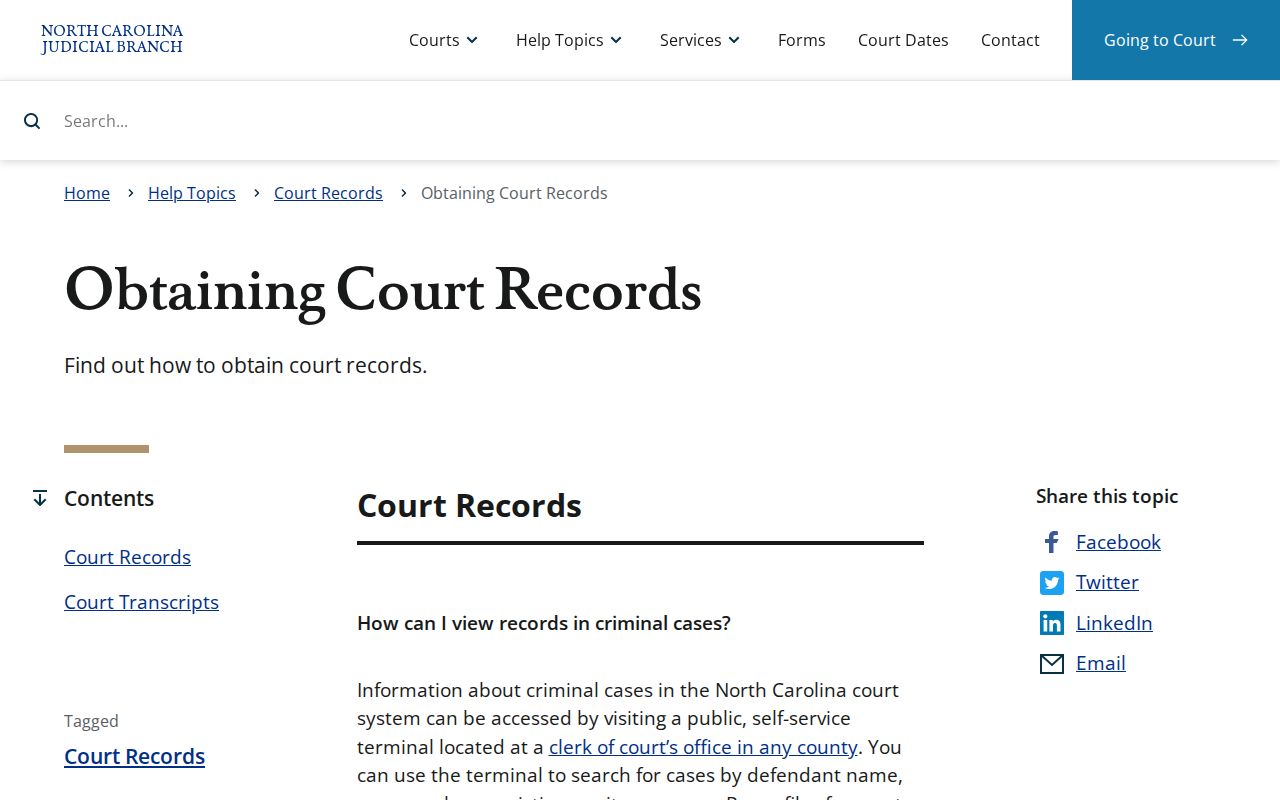
The access instructions show why the courthouse remains the authoritative next stop when an online Alleghany County case summary is incomplete.
Access & Restrictions
North Carolina law generally opens court records under clerk supervision. N.C.G.S. §7A-109 supports public inspection and authorized remote access. Yet juvenile cases, sealed matters, confidential documents, protected victim or minor data, and sensitive identifiers do not appear like ordinary adult files. Unreturned criminal warrants also require elevated access. Redaction can leave a public docket visible while keeping a protected document or field out of view.
Alleghany County court records are held at 12 North Main Street, Sparta, NC 28675. The clerk is open weekdays from 8:00 a.m. to 5:00 p.m. and can be reached at 336-372-3900. Call before a trip if the needed item is old, archived, or unclear. The clerk can explain access and copy procedure but cannot give legal advice. The Judicial Branch administrative-record request is not the route for county case files.
When Alleghany Case Search Fails
“No cases match” does not prove that a person has no court record. Check spelling, aliases, the county filter, and the four-part North Carolina case format. A partial case number needs at least four characters followed by an asterisk. A party wildcard uses at least three last-name characters plus an asterisk and at least one first-name character plus an asterisk. Restrictions, reporting lag, or an older paper record may also explain an empty result.
The official search guidance pictured here explains case formats, filters, hearings, and judgment searches.
Use those format rules first, then ask the Alleghany clerk to check the terminal and any older file rather than guessing from one blank screen.
Note: Portal is a public court index, not a certified background check or a fingerprint-based SBI criminal-history record.